Hearing the Plea from Those Who Need Encouragement – January Encourager’s Devotion


Paul to Timothy

Paul to Timothy (NKJV)

Image Source

 Welcome to The Encourager’s Devotional Series. I’m so glad you took the time to see what it’s all about. Before we dive into the devotion, here are a few notes about this devotional series:

Since this is the first post in a series that will continue throughout 2015, you may want to take a look at the introduction to the series (if you haven’t already) for information regarding the schedule for posting and what you can expect in the weeks to come.

Throughout the devotions, I will present many ideas on how you may apply what you’re learning to minister encouragement to others. I pray you will see the suggestions not as a list of “to do’s” (who needs any more of those?!), but as “prompts.” Let the Spirit stimulate your thinking, but don’t let it stop with just thinking. As you read, make note of anyone who comes to mind. Then, “be diligent” and “make every effort” to minister to someone with encouraging words and deeds.

For this first devotion, it may help to get out your Bible and turn to 2 Timothy. All Scripture quotations are from the New International Version (NIV) unless otherwise noted. You might want to read the whole book (it’s a short one) before you read the devotion. Or, you may just choose to have it open for reference during your devotional time. Either way, I hope you enjoy the devotion!

~~~~~~~~~~~~~~~

The Apostle Paul’s writings are so uplifting I don’t often think of him as someone who needed encouragement himself. Although, it does make sense. After all, he was often beaten, imprisoned, and bad-mouthed – both by unbelievers and by those who claimed to be of the faith. So, let’s look at Paul first as the encourager in order to gain insight as to how we might also be effective at this ministry even when we are experiencing hard times ourselves. Then we’ll look at Paul as the one in need of encouragement to help us recognize different ways others may need help.

The Encourager’s Perspective

In 2 Timothy, we find that Paul is near the end of his life. He is in prison, still facing opposition, and many of his friends have deserted him. After all he has done for the church, he seems to be concerned that some people are ashamed of him.

Yet, in the midst of all these trying things, Paul declared that the Lord was his sustainer and his deliverer. That Paul could stay so positive and focused on ministry during his own difficulties is something to consider as we seek to become encouragers. Paul did several things to maintain his ministry focus even when he himself was discouraged.

  • First, he reminded himself of the truth of the Gospel and the end result of the Christian life (2:9,11,12; 4:8; see also Rom. 8:18-39).
  • He also reminded himself of how God had helped him in the past (3:11).
  • He reviewed and showed thankfulness (1:16-18) for how others had blessed him in the past (reminding me of his words in Philippians 4:8).
  • And finally, he kept the needs of others in mind, even being willing to sacrifice himself for their sake (2:10).

Following these practices of Paul, we can keep ourselves encouraged, so we can then be uplifting to others. As Paul said, we should bring the Word to others and encourage them both “in season, and out of season” (4:2). In other words, we should do it even when our own conditions are less than favorable. Once we’ve geared ourselves up to become encouragers, we then need to become observant of those around us, intentionally looking to find people who need this ministry. As with Paul, someone people might not come to mind right away because they seem to have things in their lives under control. So we have to ask God to show us the real needs people have, sometimes despite their outward appearances.

Another Perspective: Paul’s Pleas for Help

Using Paul’s list of needs can prompt our thinking as to how we may help others this month.

  • Paul had an obvious physical need – he wanted a coat because it was soon to be cold (4:13,21). Can you help relieve someone’s winter worries by giving clothing, paying a heating bill, or running an errand for a shut-in? Is there a ministry in your area you might partner with to meet such needs?
  • Paul also had a spiritual need – to be reminded of the Christian’s ultimate victory as he struggled. Through cards, conversation or messaging, can you share the Word of God with someone to encourage them to persevere?
  • Then there are his emotional needs – Paul repeatedly expressed the desire for understanding and companionship (1:4; 4:9; 4:21). Notice how he appreciated that one friend actually went out of his way to be with him (1:16-18). Paul needed to know that he still had supporters, that not everyone was ashamed of him. Can you go out of your way to spend time with someone who’s lonely? Do you know someone who might feel a sense of shame for what they’re going through? Your companionship can help them feel accepted and loved.
  • And finally, Paul required help with his ministry (4:11). Can you come alongside someone to help in their ministry, even for one day or one task?

Remember, you don’t have to do everything that comes to mind as you contemplate the suggestions for ways to lift the spirits of others. But it is important to be diligent in seeking such opportunities. The world needs more encouragers.

Let’s do our utmost to go to those who need to be encouraged.

And, let’s hurry, before the cold becomes unbearable!

Next Wednesday, I’ll post the follow-up Bible study guide for this devotion. I hope you’ll continue to participate and let me know how you are finding ways to reach out to others who need to be refreshed.

proverbs-11-25-pic

Image Source


INTRODUCING The Encourager’s Devotional Series …

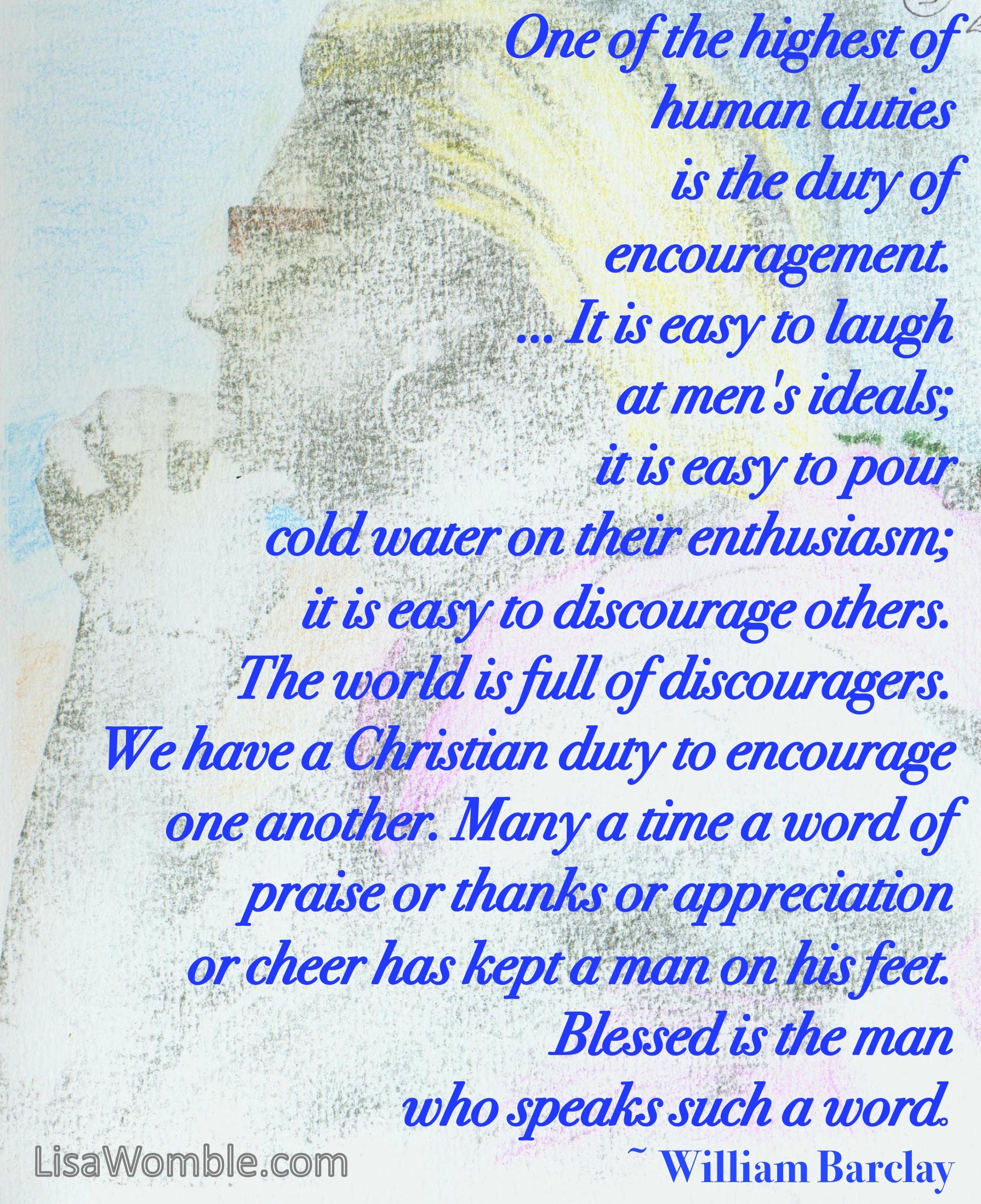
The idea for an “Encouragers Ministry” came to me after reading Hebrews 10:24-25 which says, And let us consider how we may spur one another on toward love and good deeds … encouraging one another …” In a commentary on that passage, William Barclay1 said:

Barclay on Encouragement

As Barclay notes, it just seems to be easier to discourage one another than to encourage. And yet, encouragement is such a wonderful and much needed thing. How powerful it could be if we set our minds on becoming more encouraging people. Unfortunately, the rigors of everyday life keep us from developing this ministry as we should. It takes focus and practice; it is something we must be intentional about doing. So, I thought, maybe if even just a few people decide to be intentional about developing encouragement skills … And thus, this devotional series was born.

Originally, I sent the devotional out in hard copy to subscribers. Each month they would receive the devotion, a companion Bible study, and suggestions on how to apply the study. Some used it as a group study to start an “Encouragers Ministry” in their church or with a group of friends. But many individuals have worked through the material on their own as well and found it rewarding.

When shipping the materials in hard copy format, I always included a little something “extra” – bookmarks, magnets, note cards, craft ideas and such – which could be used by the recipients as reminders of the monthly focus or be given away to others they sought to uplift. The hard copy version is still available. If you would like to subscribe, email me (pullupachairwithlisa@gmail.com).

This is the first time I have tried to put the devotional into digital form, so bear with me as I experiment with format. And feel free to leave me suggestions in the comments.

Here’s what you will receive if you follow this series on my blog every Wednesday:

A year’s worth of monthly devotions with messages to encourage you personally and inspire you to minister encouragement to others.

An accompanying study guide with four sections:

  • Information – additional reading, further thoughts on the month’s texts, and Bible study questions.
  • Meditation – things to prompt personal reflection as to how the devotion may be speaking to you.
  • Application – a section for ideas (both yours and mine) for activities you may want to do, people who come to mind as you’re reading, and personal promptings you may want to act on. This is kind of the “brainstorming” section, so all options should be considered.
  • Dedication – a place to write down things you want to commit to doing for that month or in months ahead. This last section may contain both personal and group project ideas.

I will post something related to the devotional series every Wednesday according to the following schedule:

1st Wednesday of the month – the devotional reading.

2nd Wednesday of the month – the study guide.

3rd Wednesday of the month – the answers to the study guide.

4th Wednesday (and the 5th if there is one) – my new version of the “something extra” I used to include in the hard copy. It might be a video, a tutorial, a link to a ministry idea or … well, I’m not sure yet. But I can tell you, I am passionate about this topic. I look forward to finding new ways to “spur you on to love and good deeds.” I am excited to share this journey with you.

To make sure you don’t miss any of the posts for the Encourager’s Devotional, click on my right sidebar to subscribe by email to follow me on WordPress.


1William Barclay, The Letter to the Hebrews, The Daily Study Bible (Edinburgh: The St. Andrew Press, 1955), pp. 137-138.

My First Year of Blogging – 2014 in Review

The WordPress.com stats helper monkeys prepared a 2014 annual report for this blog. See what’s happened since Lisa started her blog on May 8, 2014.

Here’s an excerpt:

The busiest day of the year was October 16th with 81 views. The most popular post that day was 5 Controversial Statements about Race and Gender I’ve Really Wanted to Post on My Blog but Haven’t – Until Now.

Click here to see the complete report.

One Aspect of Male Privilege Actually Surprised Me When I Became a Pastor

After reading Dr. Jeremiah Gibbs’ excellent post on “Women Pastors and Male Privilege”, I was compelled to add one additional category to his list of the ways male privilege is manifested in this setting.

I have been surprised at the number of people who question my role in counseling male congregants. In the almost 30 years my husband has served as a pastor, I cannot recall anyone questioning whether he should offer pastoral counsel to the women in our churches. There have, of course, been seminars and workshops on setting appropriate boundaries, and I agree completely. But there was never a suggestion that he should pass along the women who came to him for prayer or advice to a female counselor. Since we started co-pastoring together in 2009, I’ve had numerous people advise me to refer male members to my husband, even though they have come to me and not him. Interestingly, even though we are now tag-team pastors, no one has yet to say he should send the women to me.

Adding to my surprise at this attitude is the fact that it has not occurred in any other setting. When I served as principal at a Christian school and also while on the faculty at a Bible college where I was responsible for the spiritual formation program for our students, my ability to meet with and counsel fathers and male students was never questioned. In fact, I was the one who had to insist that windows were built into my office doors in both settings.

I’ve never heard a discussion about whether a female therapist should take on male clients. Why the church has such a hang-up on this has taken me aback.

Response to the Church of God in Christ’s Threat to Pull Its Convention from St. Louis

The headline reads, “Church of God in Christ threatens to pull convention from St. Louis.” And my heart sinks.

According to this and other news reports, the Church of God in Christ (COGIC) is not the only organization that’s considered pulling their events from St. Louis convention centers following the Ferguson crisis. Most are hesitant due to fear of violence in the region. Others are making more political statements with their threats to take their business elsewhere. I can understand both responses. But when it comes to a church organization, something in my gut is repelled by the approach. If it were simply a matter of fear, I’d argue that the church has always been called into dangerous situations and must simply trust that God will protect them as they do what they are called to do. But COGIC’s motive falls into the latter category of flexing its political (and economical) muscle.

Should the church be involved in political causes? Yes. It’s our right as much as any other people group to be involved in the political processes of our nation, and I even believe we are morally obligated to utilize this privilege for the good.

Should the church use its monetary resources to impact the world around us? Most certainly. And again, I’d say it’s our moral obligation to be good stewards of the financial blessings we have been given.

Since 2010, COGIC has indeed blessed the St. Louis area during its convention stays. According to COGIC’s own convention recap, the work convention attendees, some 40,000 plus, accomplished while in St. Louis this year included the following.

During the Church of God in Christ (COGIC) 107th Holy Convocation in St. Louis, MO, November 3-11, 2014, many tremendous things occurred that demonstrated the church’s love for community and for the whole man.

Through a number of COGIC Cares initiatives, the St. Louis and metro east communities were helped in some of the following ways:

During our Health Fair and Job Fair, hundreds received free healthcare services while many unemployed attendees were able to network with St. Louis employers;

5,000 people received assistance in the form of food, clothing, blankets, toys, haircuts and medical check-ups at our Christmas in November event on Saturday, November 8, 2014;

Members of our denomination dispersed within the North St. Louis Fourth Ward community to provide cleanup assistance to blighted areas; and

Several COGIC leaders visited a St. Louis Public School to conduct “a day of reading” among elementary school children.

In his official video response on the convention, Presiding Bishop Charles E. Blake added, “Prior to the convocation, denominational leaders and members went into Ferguson to support and to participate in the struggle for justice after the shooting of young teenager Michael Brown.”

After such an impressive list of loving action, charitable endeavors, and positive activism it is hard to imagine the church following all that with the threat of discontinuing its positive work here if local politicians don’t meet specific demands. I have no specific grievances with the list of demands, as presented in COGIC’s letter to Governor Nixon. There are legitimate concerns that I, too, hope to see local government continue to address. My issue comes with the idea that they are demands, made by the church, to political leaders.

To me, this is akin to Jesus saying, “I’m no longer going to feed thousands of hungry people, or continue to heal the sick, or minister the gospel of spiritual deliverance to your region if your political leaders don’t do what I think is appropriate.” Jesus never did this, despite the fact that His people were oppressed by both the Roman government as well as corrupt Jewish leaders. He continued to do good and to teach His people how to live godly lives in trying times. His church should follow His lead.


4 Motivating Reasons to Start Your New Year’s Resolutions NOW

After finishing up our church’s small group study of Radical by David Platt, we decided to commit to The Radical Experiment. It’s a year-long commitment to five specific challenges:

  • To pray for the entire world
  • To read through the entire Word
  • To commit our lives to multiplying community
  • To sacrifice our money for a specific purpose
  • To give our time in another context

We started working on several of the challenges immediately. For the prayer goal, we’re beginning with Operation World’s 60 day prayer experience. It’s an app that provides the history, statistics and prayer needs of a different people group each day. After the 60 days, we’ll find another resource to help us continue our prayer efforts. We decided on a chronological reading plan for the Bible challenge and have begun our reading. We’re also planning a mission trip with Casas por Cristo for March and we’re raising funds for that.

While doing the Bible reading plan and prayer experience, I’ve thought how these are usually the tasks I start at the beginning of a New Year. I’m finding it refreshing to start some New Year’s resolutions before the New Year actually begins. Here are four benefits I see to starting early:

  1. Starting now is proactive instead of reactive. Being proactive means looking ahead and planning for challenges instead of just reacting to them after they hit. We all know New Year’s Resolutions are difficult to keep. Starting early provides opportunity to work out the kinks and make adjustments to be more realistic with our goals.
  1. Starting now fosters a mindset that deals effectively with setbacks. Since I’m taking action prior to the official start date, if I miss a day here or there it doesn’t feel like defeat. And if I miss a day in 2015 it won’t undermine the whole process because I’ll have made deposits into the “resolution account” to balance out the negative days.
  1. Starting now is motivating because it doesn’t begin with the concept of failure. New Year’s resolutions often feel like attempts to reboot or refocus on something I’ve failed at previously. In 2015, my goal will be to continue something good I’ve already started instead of trying to muster up the enthusiasm to begin something I’ve been putting off for far too long.
  1. Starting now is creating momentum, which should lead to a more successful approach to the resolutions. When the New Year starts, I’ll already have established the good habits I’m working towards. I will enter the 2015 feeling like I’m ahead of the game. I like the idea that I’ll start the New Year off with some accomplishments already made towards my goals.

This approach to my Bible reading and prayer goals has been so positive and motivating that I’m starting on a few more resolutions now instead of waiting. One such goal is related to this blog. To date, I’ve been blogging inconsistently, whenever the mood strikes and/or I make time for it. I’m now planning a posting schedule for 2015. I’m particularly excited to work on turning my “Encourager’s Devotional Series” into a blog feature. This was something I used to send out to email subscribers and Bible study groups. I’ve been told many times, for MANY years, I should create an internet version. Looks like it’s time to get to it. Stay tuned for that and an overall schedule – and remember, I hope to be posting it BEFORE the New Year begins. 🙂

What challenges or goals have you been putting off until the New Year? What resolutions to you begrudgingly put on your list every year only to have forgotten about them in a few months? How might starting now change your success rate?

“A Book that Cannot Be Ignored”

Book reviews and a link to a chapter excerpt from my husband’s book 95 Theses Which Dispute the Church’s Conviction Against Women. This book is a thorough work on the subject, including exegesis of key passages, theological framework for discussion, as well as more pragmatic implications. Scot McKnight calls it “a book that cannot be ignored.”

5 Controversial Statements about Race and Gender I’ve Really Wanted to Post on My Blog but Haven’t – Until Now

If you’ve read much on my blog at all, you’ve probably noticed I’m a promoter of peace. I encourage people to look at all sides of an issue and strive for healthy dialogue. You’ll see on my “About This Blog” page, that one of my goals from the start was to bring people “to the table” and let their voices be heard. Among the six goals I list for the blog is the following:

Conversation – I believe the best solutions come when we do life in community. Whether we’re looking for answers to global problems, theological debates, or just day-to-day conundrums, we’ll take a look at varying opinions and develop an ear to really listen and hear what others think and feel about the issues at hand. Open-mindedness and civility will be part of our core values, but that doesn’t mean we’ll tip-toe around the issues.

Tonight I’m wondering why I’VE been tip-toeing around the issues that are very important to me. Why am I not really letting MY voice be heard?

I can come up with several answers that sound good on the surface. For instance, I’ve kind of prided myself on the fact that as much as I’ve written on the topic of Ferguson/Mike Brown (nine posts), I’ve not tipped my hand to let people know where I stand on the particulars of the situation. In this case, I’ve viewed myself more as the moderator than the debater. But I do have some definite opinions on the matter (get ready, they’re coming below).

Then there’s the issue of gender equality. As a woman pastor, I have experienced much opposition, discrimination and even hateful behavior in my life. And yet, I have only one post in the category of gender issues here. For that, I really have no excuses.

After writing those last two paragraphs, it seems obvious to me why my blog has not accomplished the goal of creating the dialogue I had hoped. How can I expect others to be comfortable expressing their opinions if I’m not comfortable expressing my own? So, with no more ado, here’s my list of controversial things I’ve wanted to say on my blog but haven’t. It’s a partial list, but it’s a start.

1. “Stop snitching” is no different than cops covering for cops. If you hate one you have to hate the other. If you oppose one, you have to oppose the other. If you protest against one, you have to protest against the other. They are the same thing. Both hide the truth. Both give preference to the perpetrator over the victim. Both hinder justice.

2. I am sick of the hate mongering of racists and sexists, especially from those who profess to be Christians. You might be a racist or a sexist if …

  • The only social media posts you make are about how despicable the “other side” is. Can you seriously not see one valid point your “opposition” is making?
  • You post ugly stories about the other gender or another race to justify the ugly stories you see about your own. You don’t post these stories to show how sad the situation is, or to foster discussion with the opposition. You do it to stir up your side in anger. You do it solely to prove this is why your side is “provoked” into doing the ugly things it’s doing.
  • Your side has done absolutely nothing wrong, ever.

3. Wal-Mart is not the same as Woolworth. The sit-ins at the Woolworth stores in the 60s made sense. Woolworth had a policy of denying blacks the right to sit and eat at their lunch counters. The sit-ins there showed courage and took action against the actual perpetrator of the injustice. It is not the same with Wal-Mart and the shooting of John Crawford. Wal-Mart just happened to be the location where a terrible tragedy occurred. If you want to stage a protest that actually convinces the other side to hear you out, do it in a location and a manner that makes sense. Shutting down a business that was an “innocent bystander,” and creating loss of income for the employees, only furthers the annimosity of those who are prone to turn a deaf ear to you in the first place.

4. To completely throw your support behind Officer Darren Wilson before all the facts are known is just as incredulous as throwing all your support behind Mike Brown before all the facts are known. Yet, again, both sides see the injustice on the one side, but not on their own. I am flabbergasted.

5. I will not have my “role” in the church, society or home defined by the curse found in Genesis 3. I do not understand how the ONLY result of the curse which is defined as “God’s creative order” or “original plan” is the one line that says man shall rule over woman. In every other aspect of the curse – the serpent will now crawl on its belly, woman will have pain in childbirth, man will have to struggle with the earth to get his food – no one will say those things are God’s original plan or desire. They are all seen as the results of sin and the fallen state. Yet, man’s rule over woman is not? I understand that a full theology of the roles of men and women must encompass the whole of Scripture, but how can we even move on to further discussion if the foundational premise is this flawed?

I was wondering how I was going to conclude this seemingly hodgepodge list post, but as I wrote that last sentence the connection of all the points became clear to me. The basic issue behind all of these controversies is the inability, or unwillingness, of one side to concede ANY point to the other. Likewise, there is a failure to recognize ANY common ground.

One place of commonality for those active in the causes of both gender issues and racial equality is supposedly a call for justice. So, let’s start by talking about justice itself – with open minds and open hearts – with a true desire to have justice for ALL. It might start by asking questions like the following and really listening to the perspective of the other. Where do you feel like I have been unjust? Do I come across as saying justice for me is more important than justice for you? How can we work together more effectively for the cause of justice? What will a just society really look like?

And more specifically in the realm of Christian dialogue on these matters, our common framework is supposed to be the love of Christ. So, the questions to start with might be … How do you feel I have been unloving towards you in this debate? Is our approach to this issue showing Christ’s love towards each other and to the world?

Now that I’ve overcome my hesitations and thrown all this out there in the blogosphere, I’m sure I’ll have some follow-up posts. I hope you will join me at the table today and in the days to come.

Justice AND Mercy, Truth AND Love

Justice AND Mercy, Truth AND Love

This video was a perfect backdrop to the prayer I shared earlier in regards to the issues we are facing here in North County, St. Louis in the aftermath of the death of Michael Brown. So often we want only one component of God’s plan. We separate out things that should go together – Justice AND Mercy, Truth AND Love. We also separate ourselves from others based on which end of the spectrum we want to align ourselves with, but the ultimate answer lies in alignment with the fullness of God’s commands. Micah 6:8 follows the instructions to “do justice and love mercy” with “walk humbly with your God.” It is difficult for us to find the balance between extremes. That is why we must humbly acknowledge that God’s ways are better than our ways and seek His guidance in these times. The two sides will only come together when both acknowledge the need for both justice and mercy, both truth and love.

Praying for My City

I live in North County St. Louis, less than six miles from the rioting and looting that has resulted from the shooting of Michael Brown by a police officer. My heart has been so grieved as I’ve watched these events unfolding – from the sadness of the shooting itself to the chaos that has surrounded us tonight. I knew I would not be sleeping anyway, so I decided to spend the time in prayer for my city and asked Facebook friends to join me. To help promote even more prayer for this situation, I’m sharing one of my posts here:

Given that the Church is called to continue the ministry of Christ, I offer this prayer based on Luke 4:18-19 …

“The Spirit of the Lord is upon Me” – Lord, help us to recognize that You are with us. Your Spirit enables Your people to have wisdom and power. Help us to be sensitive to the leading of Your Spirit, act and speak with wisdom, and be confident in Your power to handle this situation.

“Because He anointed Me to preach the gospel to the poor.” – Help us to remember that the ultimate solution to all societal ills is to lead people to You. I pray that we will be living examples of the power of the gospel to transform lives. May people see hope in this message. I pray we live in a manner worthy of this calling.

“He has sent Me to proclaim release to the captives” – Dear God, I pray that people would be freed of the chains that bind them to the sins that lie behind the chaos we see. Hatred, bigotry, judgmentalism, pride, greed, envy, lust for power and possessions – free us from these and all other things that are in opposition to Your truth.

“And recovery of sight to the blind” – In times like these, Lord, it is so easy to put blinders on as to the thoughts, opinions, needs, and feelings of others. In our desire to state our case or make our point, we turn a blind eye to anything that does not fit into our agendas. Help us, Lord, to see clearly. Help us to open our eyes to the needs of those around us and to look at others through Your eyes.

“To set free those who are oppressed” – Help us to remember that it is our mission to speak for the oppressed. Let us not pretend that oppression does not exist. Let us see it for the evil that it is and work towards justice.

“To proclaim the favorable year of the Lord.” – Help us to have hope in You, Lord.
