Encourager’s Devotional Series – January Bible Study

If you haven’t already read the January Encourager’s Devotional, you might want to check that out before proceeding to the Bible study below. And if you need to get caught up on the details of how this series works, see the introductory post.

Note, the Bible study format will always have four sections:

  • Information – This section may include additional reading, further thoughts on the month’s texts, background information and Bible study questions.
  • Meditation – Here you’ll find things to prompt personal reflection and thoughts on how the devotion may be speaking to you.
  • Application – This is where we’ll brainstorm together to stimulate ideas for possible follow-up responses to this month’s devotion. We’ll consider activities you may want to do, jot down the names of people who come to mind as you’re reading, and note personal promptings you may want to act on after contemplation and prayer. Many options should be considered even though you may not act on all of them.
  • Dedication – In this section you’ll be challenged to write down (either in the comments section following the blog, or in your own notes) things you want to commit to doing for this month or in months ahead. The list may contain both individual and group project ideas. I hope you choose to share your commitments here or with a friend or two to increase accountability for follow-through. If you choose to note them here, I’ll personally check in on you later and try to “spur you on toward the love and good deeds” you’re hoping to undertake.


ENCOURAGER’S DEVOTIONAL SERIES –
JANUARY BIBLE STUDY

Information

Why was Paul in prison? 2 Timothy 1:11-12; 2:9 (Note: I’m providing one link here to the book of 2 Timothy so you can scroll through the book for other references. For all other Scripture references, I’ll link to those specific texts).

How do Galatians 6:8-10 and Matthew 5:10-12 advise us to respond when we are persecuted for doing good? How do these Scriptures bring encouragement?

In 2 Timothy 4:14,15 Paul has two responses to those who hurt him. What are his responses and how are they different? Continue reading

When Hearts are Revealed through Social Media


Lord, heal our hearts.

Lord, heal our hearts.

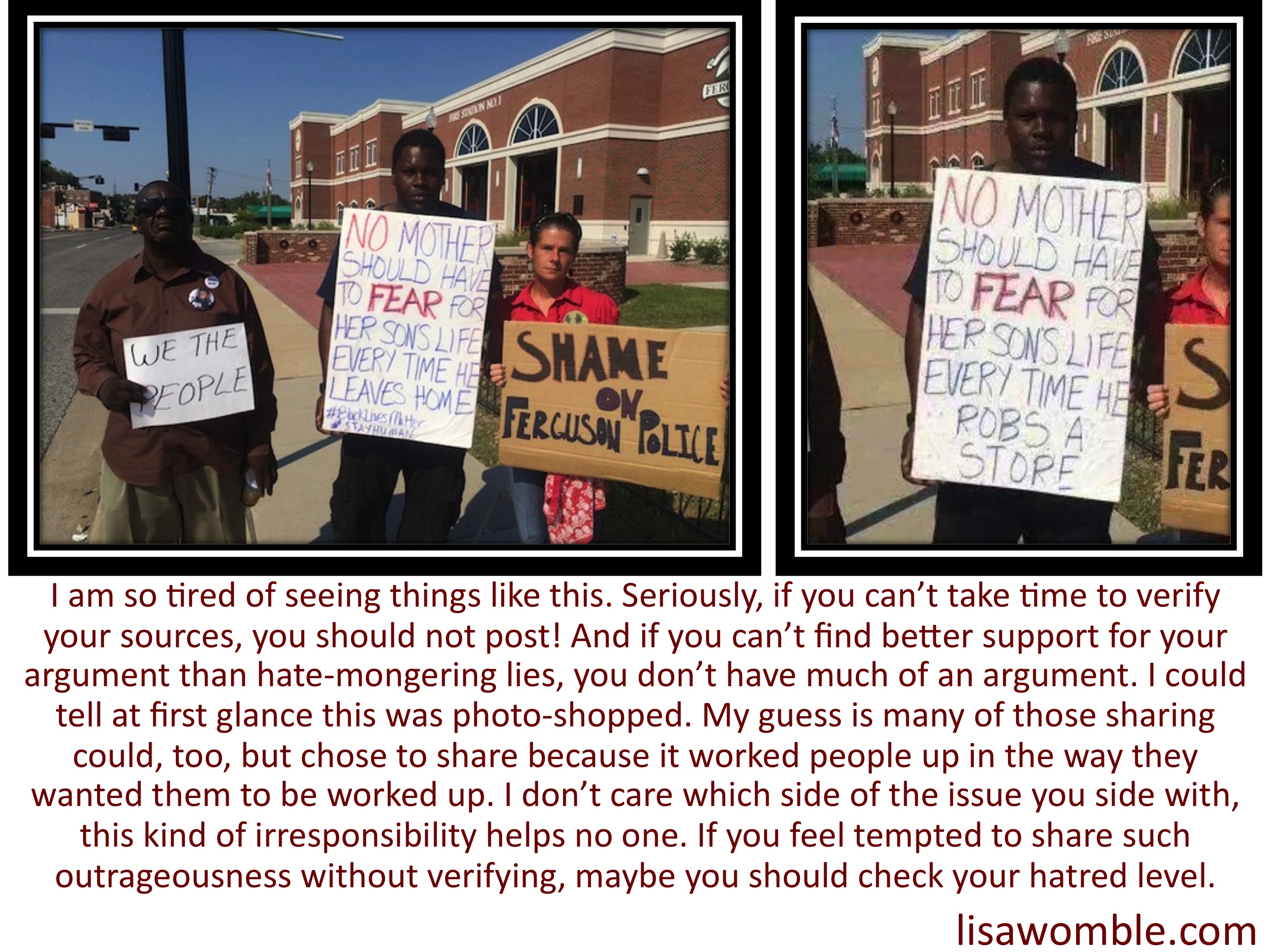
Today my heart is grieved by those who spew hatred. I’m especially troubled by those who claim to be Christ followers yet don’t seem to realize that what they post and share on social media is saying so much about their true feelings towards others. As the St. Louis area still reels from recent events in Ferguson, the last thing we need is more people stirring up animosity.

So, I was tempted today to challenge some of the posts I’ve seen. But then I thought of the Scripture in which God says He can change people’s hardened hearts from stone to flesh. Healing for our region and beyond will require dialogue, debate, debunking and determination on the part of those trying to foster peace. In this moment, though, I am not suited for the battle because my own heart is agitated.

I’m choosing instead to make the irritating posts I see my promptings for prayer:

Holy Spirit, convict hearts as only you can. Lord, please chisel away the callouses and turn these stony hearts into hearts of flesh.

Hearing the Plea from Those Who Need Encouragement – January Encourager’s Devotion


Paul to Timothy

Paul to Timothy (NKJV)

Image Source

 Welcome to The Encourager’s Devotional Series. I’m so glad you took the time to see what it’s all about. Before we dive into the devotion, here are a few notes about this devotional series:

Since this is the first post in a series that will continue throughout 2015, you may want to take a look at the introduction to the series (if you haven’t already) for information regarding the schedule for posting and what you can expect in the weeks to come.

Throughout the devotions, I will present many ideas on how you may apply what you’re learning to minister encouragement to others. I pray you will see the suggestions not as a list of “to do’s” (who needs any more of those?!), but as “prompts.” Let the Spirit stimulate your thinking, but don’t let it stop with just thinking. As you read, make note of anyone who comes to mind. Then, “be diligent” and “make every effort” to minister to someone with encouraging words and deeds.

For this first devotion, it may help to get out your Bible and turn to 2 Timothy. All Scripture quotations are from the New International Version (NIV) unless otherwise noted. You might want to read the whole book (it’s a short one) before you read the devotion. Or, you may just choose to have it open for reference during your devotional time. Either way, I hope you enjoy the devotion!

~~~~~~~~~~~~~~~

The Apostle Paul’s writings are so uplifting I don’t often think of him as someone who needed encouragement himself. Although, it does make sense. After all, he was often beaten, imprisoned, and bad-mouthed – both by unbelievers and by those who claimed to be of the faith. So, let’s look at Paul first as the encourager in order to gain insight as to how we might also be effective at this ministry even when we are experiencing hard times ourselves. Then we’ll look at Paul as the one in need of encouragement to help us recognize different ways others may need help.

The Encourager’s Perspective

In 2 Timothy, we find that Paul is near the end of his life. He is in prison, still facing opposition, and many of his friends have deserted him. After all he has done for the church, he seems to be concerned that some people are ashamed of him.

Yet, in the midst of all these trying things, Paul declared that the Lord was his sustainer and his deliverer. That Paul could stay so positive and focused on ministry during his own difficulties is something to consider as we seek to become encouragers. Paul did several things to maintain his ministry focus even when he himself was discouraged.

  • First, he reminded himself of the truth of the Gospel and the end result of the Christian life (2:9,11,12; 4:8; see also Rom. 8:18-39).
  • He also reminded himself of how God had helped him in the past (3:11).
  • He reviewed and showed thankfulness (1:16-18) for how others had blessed him in the past (reminding me of his words in Philippians 4:8).
  • And finally, he kept the needs of others in mind, even being willing to sacrifice himself for their sake (2:10).

Following these practices of Paul, we can keep ourselves encouraged, so we can then be uplifting to others. As Paul said, we should bring the Word to others and encourage them both “in season, and out of season” (4:2). In other words, we should do it even when our own conditions are less than favorable. Once we’ve geared ourselves up to become encouragers, we then need to become observant of those around us, intentionally looking to find people who need this ministry. As with Paul, someone people might not come to mind right away because they seem to have things in their lives under control. So we have to ask God to show us the real needs people have, sometimes despite their outward appearances.

Another Perspective: Paul’s Pleas for Help

Using Paul’s list of needs can prompt our thinking as to how we may help others this month.

  • Paul had an obvious physical need – he wanted a coat because it was soon to be cold (4:13,21). Can you help relieve someone’s winter worries by giving clothing, paying a heating bill, or running an errand for a shut-in? Is there a ministry in your area you might partner with to meet such needs?
  • Paul also had a spiritual need – to be reminded of the Christian’s ultimate victory as he struggled. Through cards, conversation or messaging, can you share the Word of God with someone to encourage them to persevere?
  • Then there are his emotional needs – Paul repeatedly expressed the desire for understanding and companionship (1:4; 4:9; 4:21). Notice how he appreciated that one friend actually went out of his way to be with him (1:16-18). Paul needed to know that he still had supporters, that not everyone was ashamed of him. Can you go out of your way to spend time with someone who’s lonely? Do you know someone who might feel a sense of shame for what they’re going through? Your companionship can help them feel accepted and loved.
  • And finally, Paul required help with his ministry (4:11). Can you come alongside someone to help in their ministry, even for one day or one task?

Remember, you don’t have to do everything that comes to mind as you contemplate the suggestions for ways to lift the spirits of others. But it is important to be diligent in seeking such opportunities. The world needs more encouragers.

Let’s do our utmost to go to those who need to be encouraged.

And, let’s hurry, before the cold becomes unbearable!

Next Wednesday, I’ll post the follow-up Bible study guide for this devotion. I hope you’ll continue to participate and let me know how you are finding ways to reach out to others who need to be refreshed.
proverbs-11-25-pic

Image Source


INTRODUCING The Encourager’s Devotional Series …

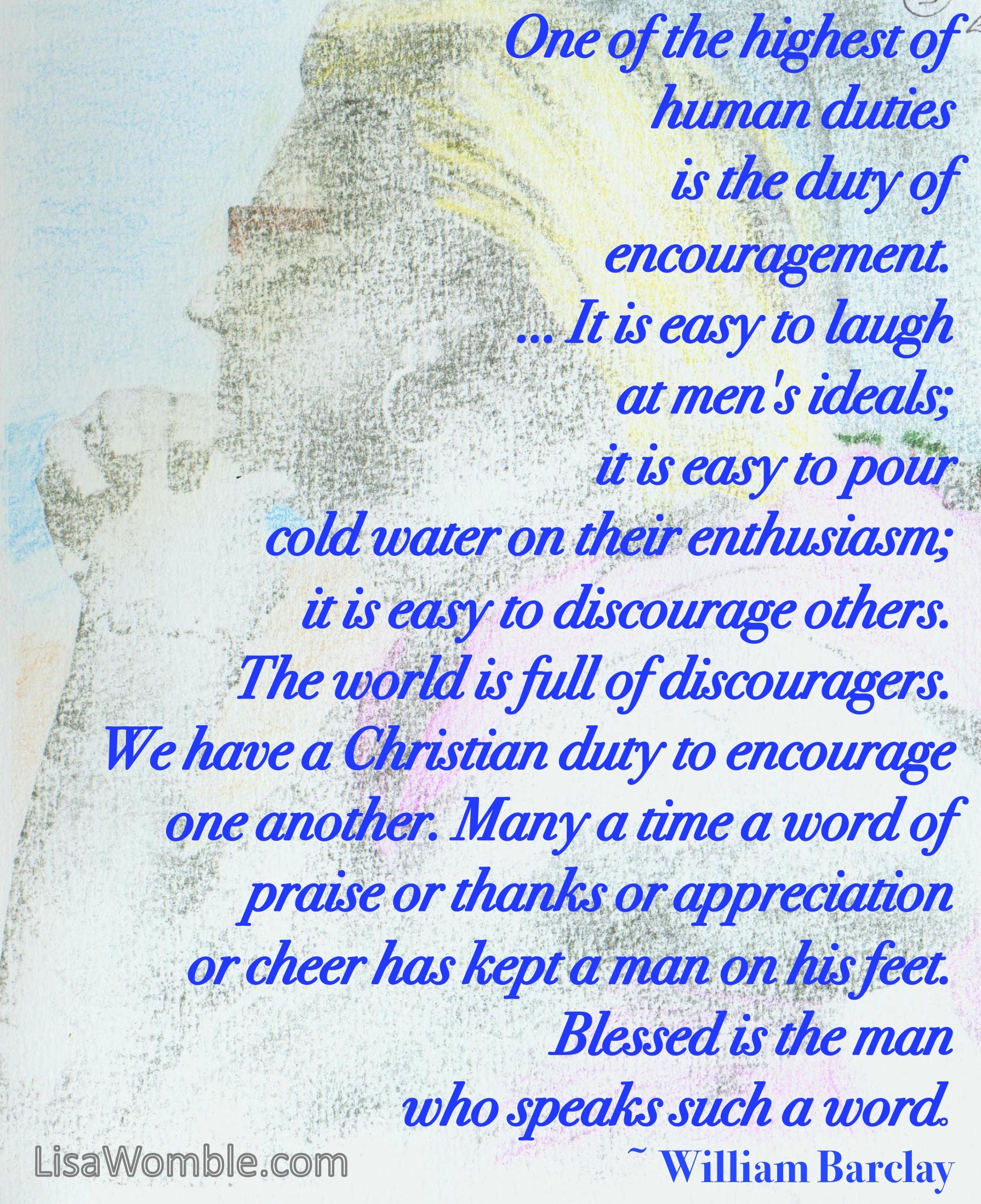
The idea for an “Encouragers Ministry” came to me after reading Hebrews 10:24-25 which says, And let us consider how we may spur one another on toward love and good deeds … encouraging one another …” In a commentary on that passage, William Barclay1 said:

Barclay on Encouragement

As Barclay notes, it just seems to be easier to discourage one another than to encourage. And yet, encouragement is such a wonderful and much needed thing. How powerful it could be if we set our minds on becoming more encouraging people. Unfortunately, the rigors of everyday life keep us from developing this ministry as we should. It takes focus and practice; it is something we must be intentional about doing. So, I thought, maybe if even just a few people decide to be intentional about developing encouragement skills … And thus, this devotional series was born.

Originally, I sent the devotional out in hard copy to subscribers. Each month they would receive the devotion, a companion Bible study, and suggestions on how to apply the study. Some used it as a group study to start an “Encouragers Ministry” in their church or with a group of friends. But many individuals have worked through the material on their own as well and found it rewarding.

When shipping the materials in hard copy format, I always included a little something “extra” – bookmarks, magnets, note cards, craft ideas and such – which could be used by the recipients as reminders of the monthly focus or be given away to others they sought to uplift. The hard copy version is still available. If you would like to subscribe, email me (pullupachairwithlisa@gmail.com).

This is the first time I have tried to put the devotional into digital form, so bear with me as I experiment with format. And feel free to leave me suggestions in the comments.

Here’s what you will receive if you follow this series on my blog every Wednesday:

A year’s worth of monthly devotions with messages to encourage you personally and inspire you to minister encouragement to others.

An accompanying study guide with four sections:

  • Information – additional reading, further thoughts on the month’s texts, and Bible study questions.
  • Meditation – things to prompt personal reflection as to how the devotion may be speaking to you.
  • Application – a section for ideas (both yours and mine) for activities you may want to do, people who come to mind as you’re reading, and personal promptings you may want to act on. This is kind of the “brainstorming” section, so all options should be considered.
  • Dedication – a place to write down things you want to commit to doing for that month or in months ahead. This last section may contain both personal and group project ideas.

I will post something related to the devotional series every Wednesday according to the following schedule:

1st Wednesday of the month – the devotional reading.

2nd Wednesday of the month – the study guide.

3rd Wednesday of the month – the answers to the study guide.

4th Wednesday (and the 5th if there is one) – my new version of the “something extra” I used to include in the hard copy. It might be a video, a tutorial, a link to a ministry idea or … well, I’m not sure yet. But I can tell you, I am passionate about this topic. I look forward to finding new ways to “spur you on to love and good deeds.” I am excited to share this journey with you.

To make sure you don’t miss any of the posts for the Encourager’s Devotional, click on my right sidebar to subscribe by email to follow me on WordPress.


1William Barclay, The Letter to the Hebrews, The Daily Study Bible (Edinburgh: The St. Andrew Press, 1955), pp. 137-138.

My First Year of Blogging – 2014 in Review

The WordPress.com stats helper monkeys prepared a 2014 annual report for this blog. See what’s happened since Lisa started her blog on May 8, 2014.

Here’s an excerpt:

The busiest day of the year was October 16th with 81 views. The most popular post that day was 5 Controversial Statements about Race and Gender I’ve Really Wanted to Post on My Blog but Haven’t – Until Now.

Click here to see the complete report.

One Aspect of Male Privilege Actually Surprised Me When I Became a Pastor

After reading Dr. Jeremiah Gibbs’ excellent post on “Women Pastors and Male Privilege”, I was compelled to add one additional category to his list of the ways male privilege is manifested in this setting.

I have been surprised at the number of people who question my role in counseling male congregants. In the almost 30 years my husband has served as a pastor, I cannot recall anyone questioning whether he should offer pastoral counsel to the women in our churches. There have, of course, been seminars and workshops on setting appropriate boundaries, and I agree completely. But there was never a suggestion that he should pass along the women who came to him for prayer or advice to a female counselor. Since we started co-pastoring together in 2009, I’ve had numerous people advise me to refer male members to my husband, even though they have come to me and not him. Interestingly, even though we are now tag-team pastors, no one has yet to say he should send the women to me.

Adding to my surprise at this attitude is the fact that it has not occurred in any other setting. When I served as principal at a Christian school and also while on the faculty at a Bible college where I was responsible for the spiritual formation program for our students, my ability to meet with and counsel fathers and male students was never questioned. In fact, I was the one who had to insist that windows were built into my office doors in both settings.

I’ve never heard a discussion about whether a female therapist should take on male clients. Why the church has such a hang-up on this has taken me aback.